

A "recruiter" you have never met messages you on Messenger: caregiver work in Canada, PR for your whole family, just send the processing fee to reserve your slot. Your cousin in Toronto is already there, says it is real. Between them sits a quiet question — your way out, or another way to lose the savings you spent years building?
Our team has watched both stories: Filipinos who walked this route into real jobs in Canada, and others robbed at home before they boarded. This guide is the difference — what is true, what it takes, what it pays, and how to spot the scam.
Why Canada Needs Filipino Caregivers Right Now
The demand is real. Canada's population is aging fast, and the health system leans on home care workers to fill the gap. These workers care for patients at home — seniors, children, and persons with disabilities, some with serious medical needs — giving daily assistance with the tasks that keep them safe. The Filipino caregivers we see thrive are not "cheap labour"; they are skilled, compassionate professionals building a career. That dignity is yours.
Two Real Routes Through Canadian Immigration: the Caregiver Work Permit and the Home Care Worker Pilots
Per IRCC and ESDC, there are exactly two legitimate doors into home care work — two caregiver immigration programs, both run by the government, not a recruiter's favour. The rest is noise.
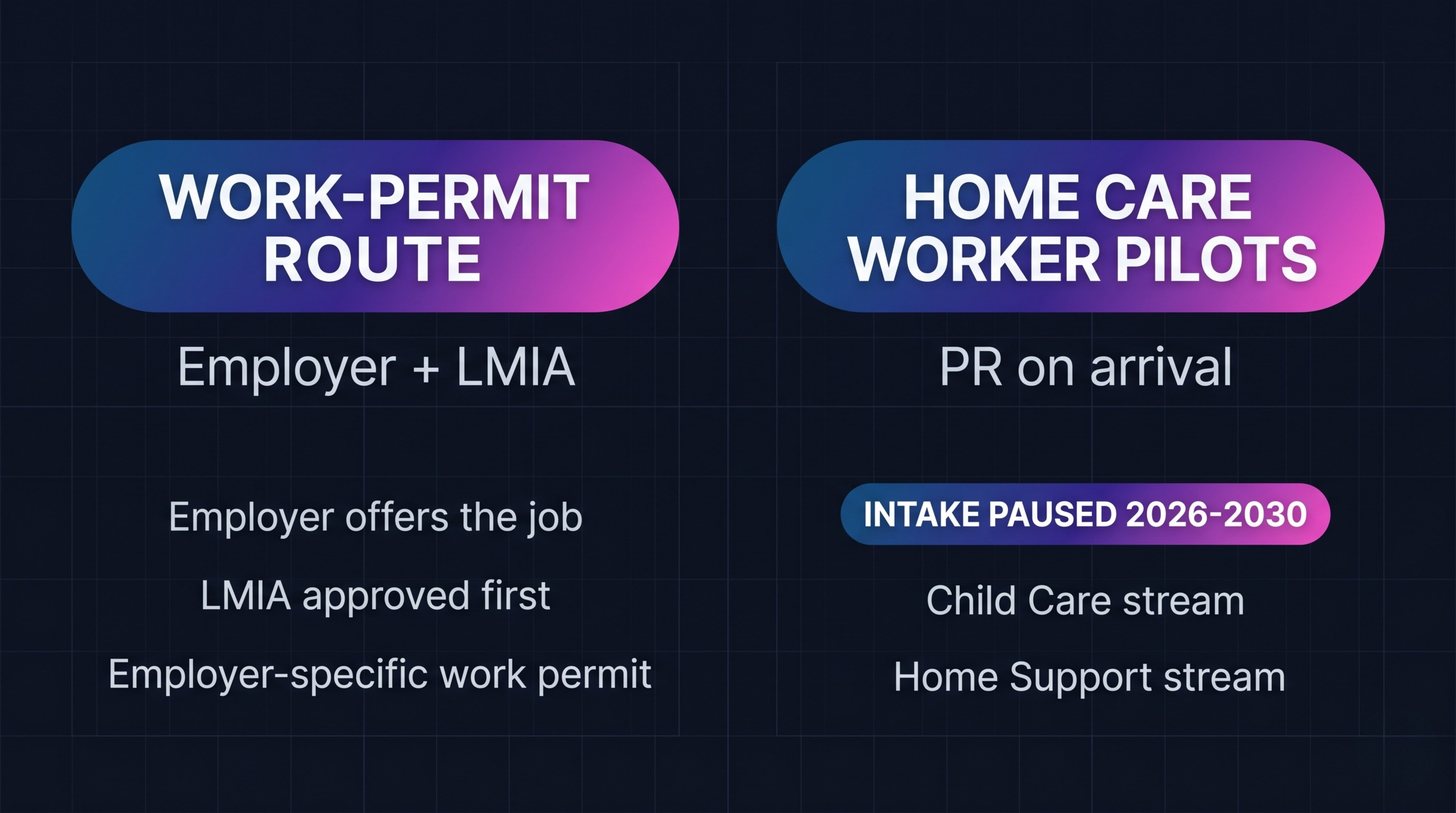
The Work-Permit Route (Employer + Labour Market Impact Assessment)
This route is employer-driven, under Canada's Temporary Foreign Worker Program. A Canadian employer — often a family needing in-home care for patients of their own — offers you the job, then applies for a Labour Market Impact Assessment: a document confirming the role needs a foreign worker because no Canadian is available. Only once that assessment is approved do you apply to IRCC for an employer-specific work permit. A genuine offer is in writing — the role, the pay, the full-time hours (a minimum of 30 hours a week) — as a temporary work permit requires.
The Home Care Worker Pilots: the Child Care and Home Support Worker Pilot Routes
These new pilots are what most people mean by "caregivers get PR." Each launched on March 31, 2025 as two streams — the Child Care stream for a home child care provider, the Home Support stream for a home support worker — and per IRCC, eligible applicants under these programs receive permanent residence on arrival. The home child care provider stream fits experience with children; home support fits seniors and adults.
Here is the honest part: each stream filled within hours, and on December 19, 2025 IRCC announced these new pilots will take no new applications from March 31, 2026 through March 30, 2030. So as of June 2026, this PR door is effectively closed to applicants outside Canada; the remaining spots go to home care workers already there. This changes often — confirm where each stream stands at canada.ca, not from a recruiter.
A closed intake window is not a closed future. The caregivers we watch actually make it abroad are rarely the ones who got luckiest with timing — they are the ones who were ready before the door opened: credential already assessed, language test already passed, real care experience already logged, their file already clean the day applications resume. Opportunity here is not waited for; it is built. Become genuinely employable and prepared first, and a paused pilot stops being a wall you sit in front of — it becomes a door you step through the moment it moves.
Eligibility Requirements: the Caregiver Experience You Need to Qualify
The kind hard-truth: qualifying for the home care worker programs is a real bar. Per IRCC, the pilots ask for:
- Education: the equivalent of a Canadian high school diploma; for a foreign credential — say, a diploma from the Philippines — a completed Educational Credential Assessment (ECA).
- Language: a minimum CLB 4 in all four abilities, on an approved test (IELTS, CELPIP, or a French equivalent). Keep your language test results — less than two years old — with the other supporting documents IRCC asks for.
- Caregiver experience: about six months of recent, relevant paid home care experience, or qualifying training of at least six months. The Direct-to-PR category counts recent Canadian work experience.
- Admissibility: a clean medical exam and a completed police clearance, which all applicants must pass.
If you do not meet this minimum yet, you are early, not out — and this is exactly the season to prepare. Book and sit the language test. Start your ECA now, so the credential is assessed long before you need it. Log every month of paid care experience in a clean, written record, and keep sharpening the caregiving skills behind it. None of this waits on a recruiter or an open intake — it is the career you are building, and it is what readiness looks like. No honest training is ever wasted.
How to Find Legitimate Canada Jobs (and Apply Safely)
Both programs still need a real job behind them. When you look for Canada jobs, skip the stranger's screenshot: Canadian employers post for home care workers when they cannot find them locally, and there is one place to read those posts.
Using Canada's Job Bank to search and apply
- Go to the federal Job Bank (jobbank.gc.ca) and create a free account — no fee.
- Sign in, then search "home support worker," "caregiver," and related occupations.
- Filter by work location and full-time roles — most jobs list home support workers under NOC 44101.
- Apply through the official website.
It is a government service: according to Job Bank, you never pay to search, sign up, or apply for these home care worker jobs.
Back in the Philippines, work only with a licensed agency. Confirm it on the Department of Migrant Workers website before you sign anything: a real agency is on the DMW list. A scam is not.
Protect Yourself: How to Spot a Caregiver Scam
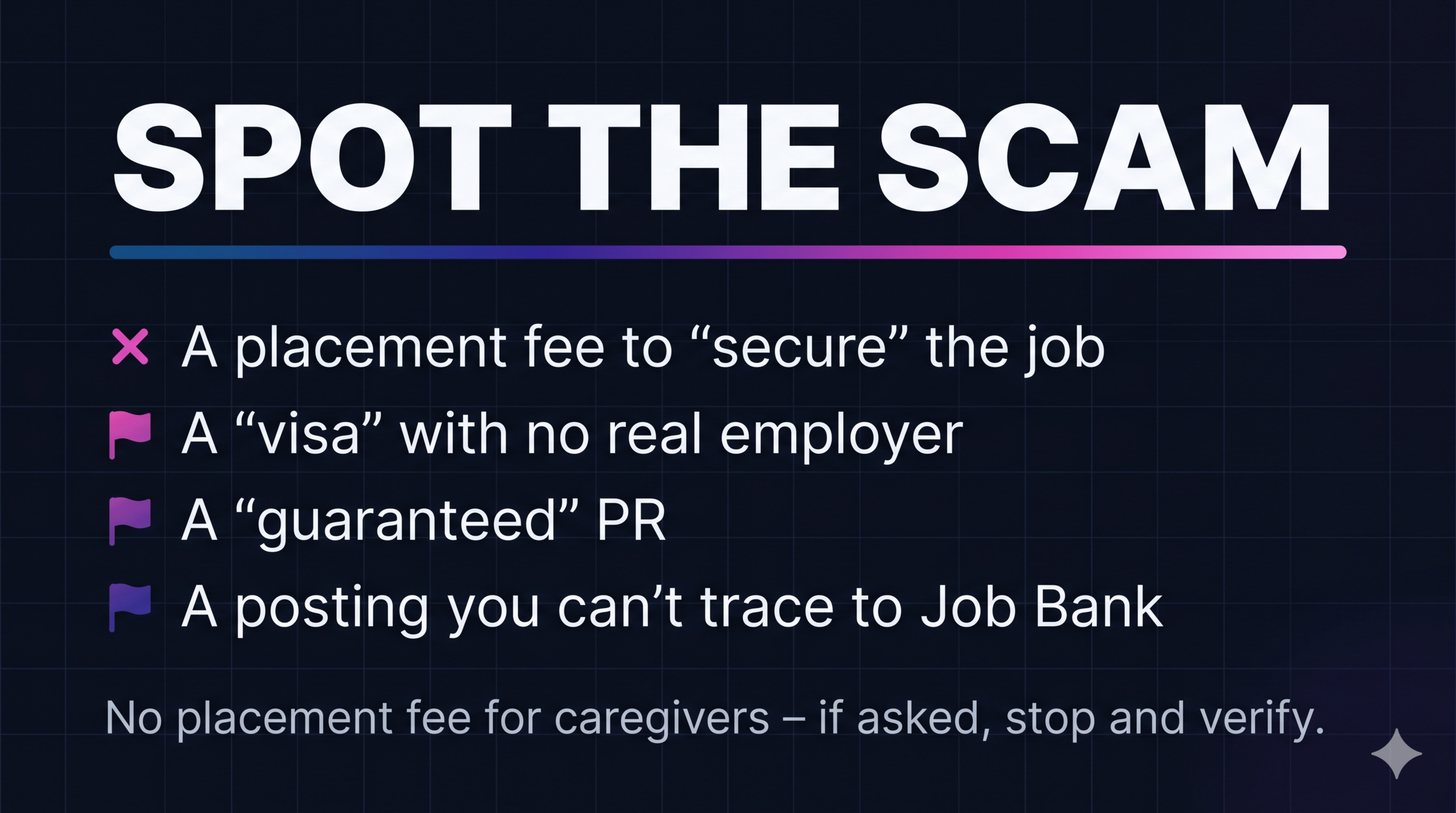
Read this twice — it is where Filipinos lose the most money, and the rule a recruiter never tells you: under DMW rules, legitimate employers do not charge a placement fee to home care workers for caregiving roles. The employer carries that cost, so a disguised fee is illegal.
Watch for these red flags:
- A placement fee to "secure" or "guarantee" the job.
- A "visa" or job offer with no real employer attached.
- A "guaranteed" PR — no one can guarantee permanent residence.
- A posting you cannot trace to a live Job Bank listing.
Carry one sentence: the moment someone asks for money to "guarantee" the job or the visa, stop and verify before you pay. If they took your money, report them to the DMW.
The PR Pathway: From Caregiver to Permanent Resident
For many home care workers, this is the dream: these are among the few programs leading to permanent residence, and that status can bring your family members — a spouse or common-law partner and dependent children. A work permit first can still matter: the pilots' Direct-to-PR category counts recent Canadian work experience. But PR through these programs is conditional, on caps and windows; outside them, you work in Canada first, then qualify, after a real wait. Because the path now runs through time inside Canada, the credentials and care experience you prepare today are what make that walk shorter when your turn comes.
Before You Apply: Get Ready Now
You cannot control when an intake reopens. You can control whether you are ready when it does — and every item here is something you can start without permission and without paying anyone:
- ☐ Confirm where each pilot stream stands today at canada.ca — not from a recruiter's message.
- ☐ Start your Educational Credential Assessment (ECA) for your Philippine diploma.
- ☐ Book and sit an approved language test (IELTS, CELPIP, or a French equivalent); aim to clear CLB 4 in all four abilities.
- ☐ Keep a clean, written record of your paid care-work experience — dates, duties, employers.
- ☐ Search real roles on the federal Job Bank (jobbank.gc.ca) — free, and where actual employers post.
- ☐ Verify any Philippine agency on the DMW list before you sign or pay anything.
- ☐ Remember: no placement fee for caregivers or household service workers — if someone asks, stop and verify.
The Questions Filipinos Ask Us Most
Can I bring my family? Yes — permanent residence can extend to your family members: a spouse or common-law partner and dependent children, who under the pilots may also be eligible for an open work permit.
Do I need to be a nurse? No — caregivers and nurses are different roles. As a home care worker, or a home child care provider on the Child Care stream, you provide assistance to patients at home: the elderly, children, and persons with disabilities, some with high medical needs. It is care work, not clinical nursing — these patients need a trained hand, not a medical degree.
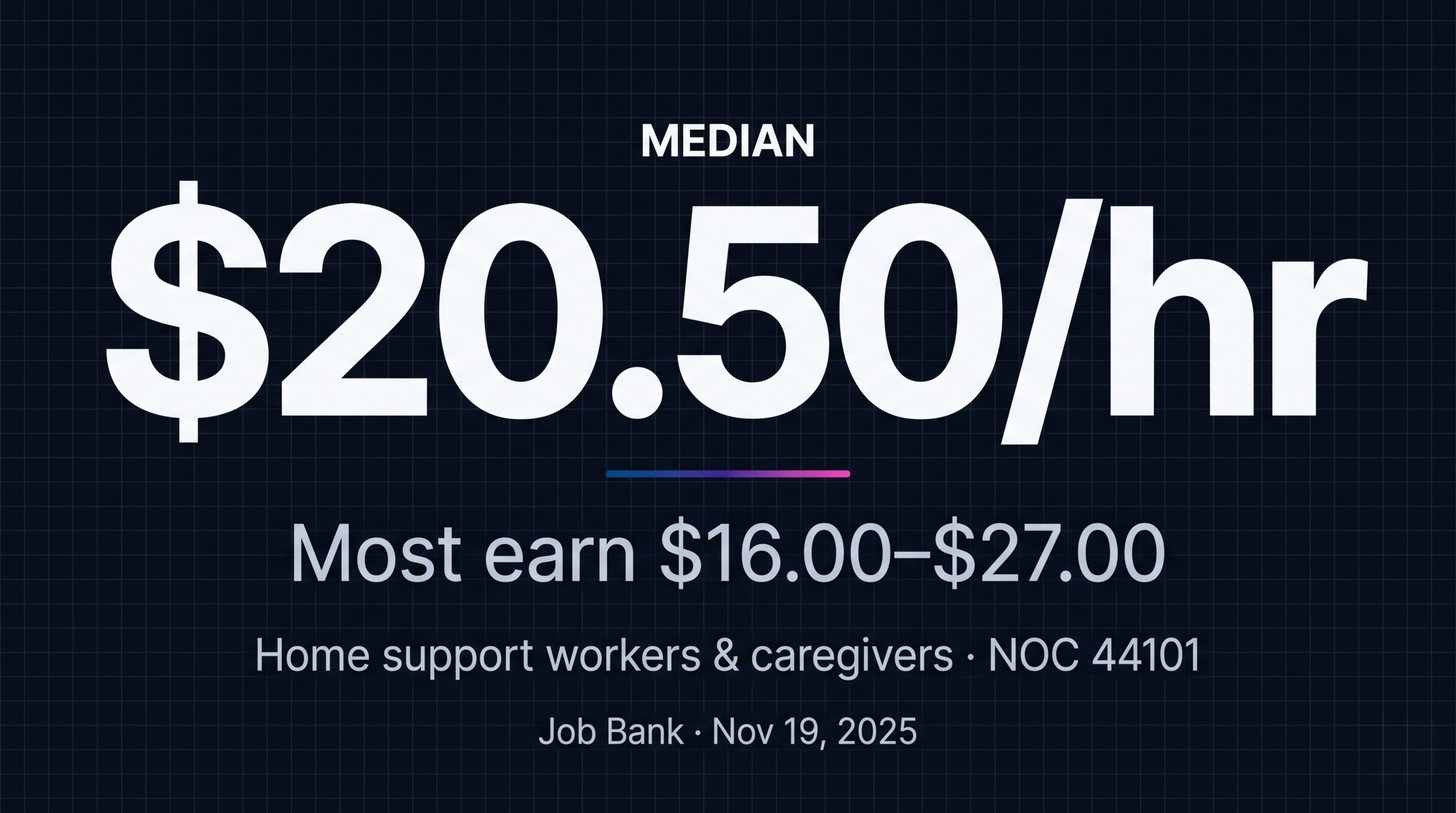
How much does a caregiver in Canada earn? For home support workers and caregivers (NOC 44101), the national median wage is about $20.50 CAD per hour, most earning $16.00 to $27.00, per Job Bank data updated November 19, 2025. Pay varies by province; Quebec runs its own rules, and the federal pilots are for applicants destined outside Quebec.
Is it true caregivers can get PR? Yes-but — it can lead to permanent residence, but only when you meet the requirements and a route is open. Real and reachable, but never guaranteed.
Now you know the routes, the pay, and which programs lead where. Confirm the pilots' status at canada.ca, then prepare your file — start the ECA, book the language test, build a clean care-work record — ready when a door opens. Big dreams start here, one careful step at a time, and you just took it.
Sources
As of June 2026 — immigration rules change, so confirm at canada.ca before you act:
IRCC — Home Care Worker Immigration Pilots (overview, PR on arrival, family members): https://www.canada.ca/en/immigration-refugees-citizenship/services/immigrate-canada/caregivers/home-care-worker-immigration-pilots.html IRCC — Ministerial Instructions (pilots' launch + intake pause to 2030): https://www.canada.ca/en/immigration-refugees-citizenship/corporate/mandate/policies-operational-instructions-agreements/ministerial-instructions/other-goals/mi86-87-88.html IRCC — Notice: pausing Home Care Worker Pilots intake (Dec 19, 2025): https://www.canada.ca/en/immigration-refugees-citizenship/news/notices/pausing-home-care-worker-immigration-pilots-application-intake.html IRCC — Pilots eligibility: education / ECA: https://www.canada.ca/en/immigration-refugees-citizenship/services/immigrate-canada/caregivers/home-care-worker-immigration-pilots/child-care-home-support/eligibility/education-assessment.html IRCC — Pilots eligibility: language test (CLB 4): https://www.canada.ca/en/immigration-refugees-citizenship/services/immigrate-canada/caregivers/home-care-worker-immigration-pilots/child-care-home-support/eligibility/language-test.html IRCC — Pilots eligibility: work experience / training: https://www.canada.ca/en/immigration-refugees-citizenship/services/immigrate-canada/caregivers/home-care-worker-immigration-pilots/child-care-home-support/eligibility/work-experience-training.html IRCC/ESDC — Caregiver work permit + LMIA (employer-driven route): https://www.canada.ca/en/employment-social-development/services/foreign-workers/caregiver.html IRCC — Employer-specific work permit (LMIA gates the permit): https://www.canada.ca/en/immigration-refugees-citizenship/services/work-canada/employer-specific.html Government of Canada — Job Bank wage report, NOC 44101 (median $20.50; updated Nov 19, 2025): https://www.jobbank.gc.ca/marketreport/wages-occupation/20667/ca Government of Canada — Job Bank (free federal job board): https://www.jobbank.gc.ca/home ESDC — NOC 44101 occupation profile (home support workers, caregivers and related occupations): https://noc.esdc.gc.ca/Structure/NOCProfile?code=44101&version=2021.0 Philippine DMW — Licensed recruitment agency verification: https://dmw.gov.ph/inquiry/licensed-recruitment-agencies Philippine DMW / POEA — no-placement-fee rule for household service workers (POEA Governing Board Resolution No. 6, Series of 2006): https://dmw.gov.ph/archives/poea/gbr/2006/6.pdf Philippine DMW — current circular reaffirming the rule (DMW MC-03-2025): https://dmw.gov.ph/archives/v1/resources/dsms/DMW/ISN-EXT/2025/DMW-MC-03-2025.pdf