

The first thing I tell a Filipino weighing hospitality jobs in Singapore is that the hotels there are not hiring a CV full of buzzwords. They are hiring someone who can stand at a front office desk at 7am, read a tired guest's mood in two seconds, and make the next five minutes easier. I grew up with more questions than resources, and it took me years to learn that the thing between a person and the life they want is rarely talent — it is the first step, taken before you feel ready. Filipinos are sought after across Singapore's hospitality industry for exactly that instinct for service, and it is why I see Filipinos on hotel floors from the budget chains on Bencoolen Street to the luxury resorts on Sentosa.
If you are searching for Filipino hospitality jobs Singapore offers in 2026, this guide walks through what the work is really like, what you will earn each month, the work pass you need, and how to actually get hired rather than just applying into silence.
What Hospitality Work in Singapore Is Really Like
A hotel runs on dozens of small jobs, and most Filipino hospitality staff start in one of four areas. Understanding the daily duties of each helps you choose your role, because the shifts run long and stretch into weekends and holidays.
Front Office
As a front office associate you assist guests from check-in to check-out, answering questions before a guest thinks to ask them. You handle guest requests and the occasional cash transaction — at the desk, on the phone, and in the hotel app — while keeping the lobby running smoothly behind you. A good associate handles a queue, a complaint, and a VIP request at once, and that is the service standard Singapore hotels promote on. When a guest arrives at 2am with a booking that didn't sync, how you handle it is the difference between a one-star review and a guest who comes back.
Housekeeping
Room attendants and housekeeping staff make sure guest rooms meet the high standard a paying guest expects in a Singapore hotel. The duties are physical and detailed: you prepare and turn over rooms and suites between guests, change linen, restock, handle the cleaning equipment and trolleys, and assist the floor supervisor in holding every standard a tired worker can miss. These rooms are inspected, so the preparation — equipment checked, safety mat laid, room set right — is the whole job. Housekeeping is the most common entry point into a hotel, and a steady attendant who keeps cleanliness and service standards high is the first one noticed when supervisor positions open.
Food, Beverage, and Service Crew
F&B service crew serve guests across restaurants, bars, and room service, and part time service crew staff the big events and weddings in peak season. Good service here is timing and warmth, and the food operations never fully stop. A good F&B team carries each other through a rush, and the ones who lead that service well move up to captain and then to outlet manager.
Kitchen
From commis to chef de partie, kitchen staff keep food moving to service through every shift. They work as a tight team under pressure, and the strong hands lead a section and move up to sous chef fast. It is a path for any Filipino with culinary skills who wants a trade that travels the world and pays.
Across all four areas, the job is the same underneath: you assist guests, keep operations smooth, and protect the guest experience. These are mostly entry level positions when you arrive, but a worker who does that well does not stay there long.
After all the workers I have met and mentored over the years, here is what I have watched, again and again: Filipinos earn their reputation in Singapore hotels by reading what a guest needs before it is said. And I want you to hear the part most people miss — that instinct is not magic you are born with. It is trained. Warmth under pressure, the patience to stay kind on the twelfth hour of a shift, the eye that notices the small thing — you build those now, in whatever work you are doing today. That readiness is your foot in the door; how you treat each guest once you are inside is what turns a job into a career.
Career Progression: From the Floor to Business Development
Yes, hospitality is a good career in Singapore, and the reason is the path, not just the paycheck. A Filipino who joins as a housekeeping or front office associate can move to supervisor within a few years, then into management. A good company promotes from within, invests in your development with real training, and the experience you build there is recognised across the region. The colleagues you join in your first month become the network that carries the rest of your career. For the rare few who truly master the floor, the ladder can lead off it entirely — into corporate roles like training, or business development for a hotel group. For a young Filipino who can assist guests well, few service industry jobs abroad offer this much, or make you feel as valued for the work itself. So start at the floor without shame and learn fast; every rung above it is built on how well you stood on the first one.
Salary: What Hospitality Staff Earn Each Month (Marina Bay Sands to the Budget Chains)
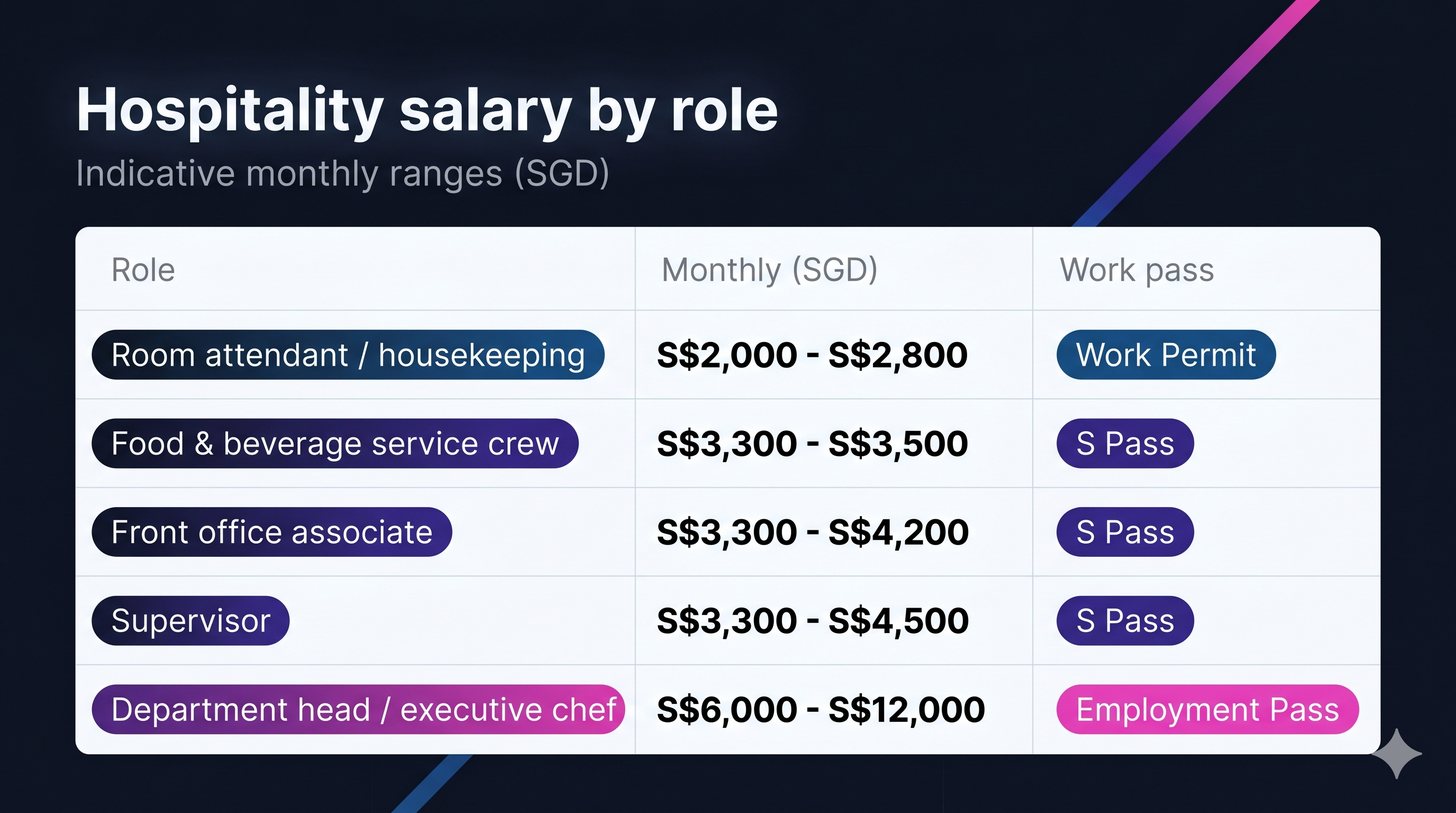
Here is what Filipino hospitality staff typically earn per month:
| Role | Monthly salary (SGD) | Work pass |
|---|---|---|
| Room attendant / housekeeping | S$2,000 - S$2,800 | Work Permit |
| Food and beverage service crew | S$3,300 - S$3,500 | S Pass |
| Front office associate | S$3,300 - S$4,200 | S Pass |
| Cook / chef de partie | S$2,400 - S$4,500 | Work Permit / S Pass |
| Supervisor | S$3,300 - S$4,500 | S Pass |
| Assistant manager / office manager | S$4,800 - S$6,500 | S Pass / EP |
| Department head / executive chef | S$6,000 - S$12,000 | Employment Pass |
These are indicative market ranges, not government figures — Singapore's Ministry of Manpower (MOM) publishes only the pass salary floors, not per-role hotel wages.
One honest note on the route in. Today, the Work Permit path for Filipinos in hotels runs mainly through housekeeping and kitchen roles, because the Philippines is a Non-Traditional Source country and only a restricted set of occupations is open to it. From 1 September 2026, MOM has announced it will open the Non-Traditional Sources Occupation List to more roles, including waiters and kitchen assistants — but that change is not yet in effect today, so confirm the current rules at MOM before you count on it.
People often ask which hospitality positions pay 10k a month in Singapore. That figure is real, but it sits at the top: executive housekeepers, executive chefs, and food and beverage directors at the big hotels and resorts — a flagship integrated resort like Marina Bay Sands is where those top-tier jobs cluster — on an Employment Pass. It is a career destination, not a starting offer. For context, senior hotel roles sit on the Employment Pass, whose qualifying salary today starts at S$5,600 a month and scales with age, according to MOM. Most Filipino workers start well below 10k and climb.
Beyond Salary: Benefits, Night Shift, and the Real Trade-offs
A full time hospitality job in Singapore comes with more than the monthly salary. Employers of Work Permit and S Pass holders are legally required to provide medical insurance, according to MOM, and staff earn statutory paid annual leave under Singapore's Employment Act. Beyond what the law guarantees, most hotels also provide meals on shift and often transport or housing support for entry level Work Permit staff — though those last few are perks an employer chooses to give, not legal entitlements, so read the contract rather than the promise.
Be honest with yourself about the hours, too. A hotel never closes, so many roles run a night shift, and a fair employer pays a shift differential for it and gives you proper rest days. These benefits are part of what lets a Filipino worker save, send money home, and build something steadier abroad. When you weigh two job offers, look at the company, the contract, and the team you would join — not only the salary.
The Work Pass Pathway
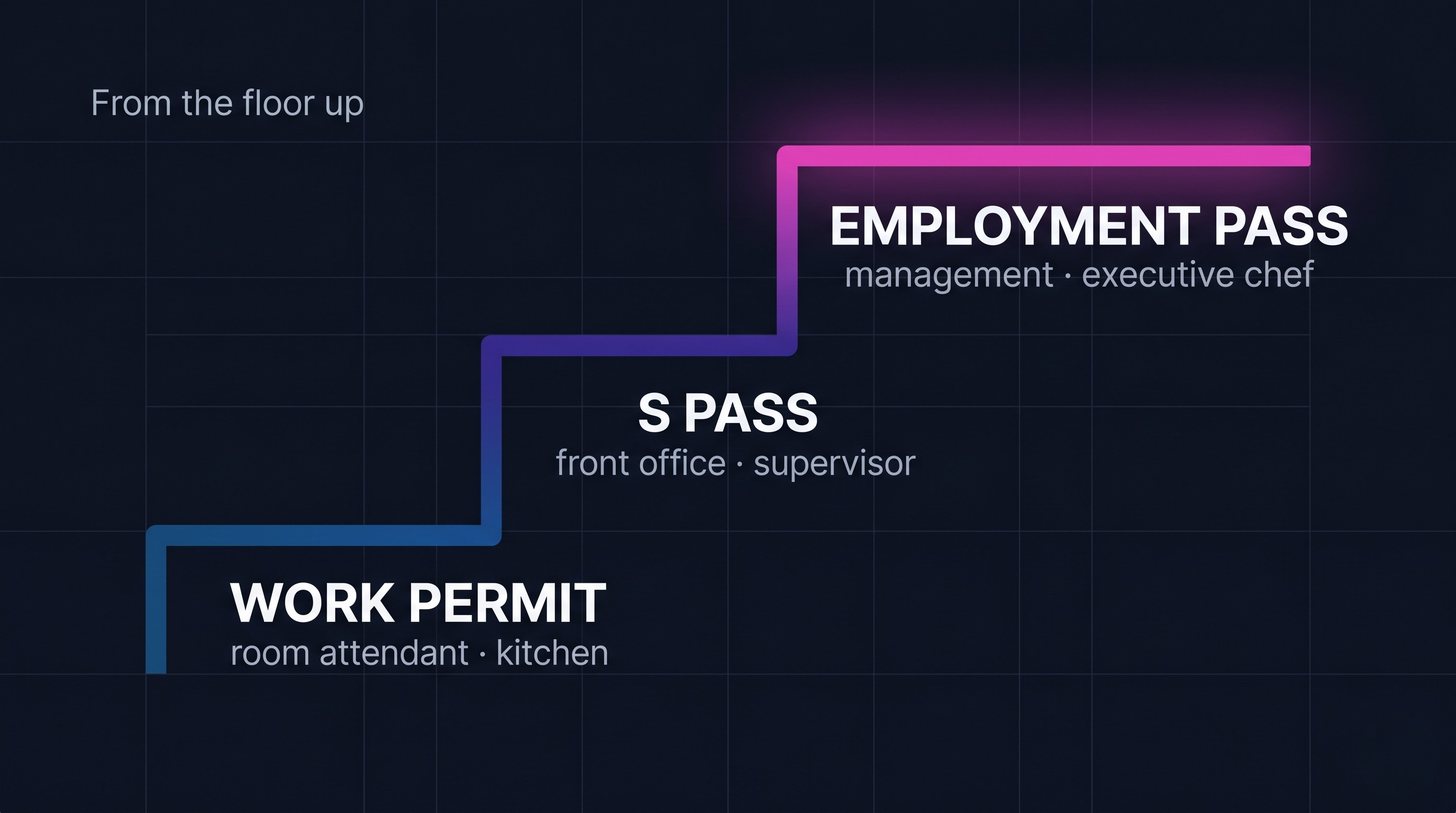
Your work pass depends on the role and the salary. Singapore's MOM issues three main passes: the Work Permit for semi-skilled hotel workers, the S Pass for mid-skilled staff, and the Employment Pass for executives and specialists. The pass follows the job — your employer sponsors you and applies on your behalf; you do not file for it yourself. Most Filipinos enter on a Work Permit and step up as their experience and monthly salary grow, so a better offer is also a better pass.
I want to stay on that one sentence, because it is the whole game and most people read it as a wall: you cannot file for a Singapore work pass yourself. The visa, the quota, the cap — none of it is in your hands. For years I watched good people burn their hope waiting at a door they were never going to open from the outside. So here is the reframe I give every one of them: stop chasing the pass, and become the person an employer cannot say no to. The job offer is not a lottery you wait to win — it is the result of being someone a hotel can hire. You cannot control the visa, but you can absolutely control whether you are ready when the role opens. Opportunity here is built, not waited for. You prepare for it, you make yourself employable, and the door — the offer, and the pass behind it — follows the person you have become.
How to Apply and Get Hired
The Filipinos who get hired are the ones who apply well, not just often. Here is the process that works for hotel hospitality positions in Singapore:
Build a Full Resume for the Role
A hotel does not want a generic CV. Prepare a full resume that names the role you want, the operations you have run, and the service skills you bring to a guest. List the training you have done and the skills you want to develop, because hotels invest in staff who want to grow. A full resume should show your professionalism on the page the way you'd show it on the floor — clean, specific, no fluff. Mirror the language hotels use, and answer any specific request a posting lists — a certificate, a language, a shift. Most entry level positions need no hard experience, so a clear resume and the right attitude carry more weight than you think. And build this now, before a posting goes live — the resume that wins is the one already written when the role appears, not the one you scramble to finish after.
Be an Early Applicant
Singapore hotel positions fill fast, so set job alerts and apply in the first days a role is posted. The early applicant gets read; a late one gets the auto-reply.
Use the Right Channels
Filipino workers find hospitality jobs through job boards like JobStreet Singapore and LinkedIn, through company careers pages, and through licensed recruitment agencies in the Philippines. Use all three to widen your shot at a job offer.
Follow Up Like a Professional
After you apply, find the hotel's hiring or talent team on LinkedIn and contact them by name. Make it easy for the company to reach you: put a working phone number and email at the top of your resume, so a recruiter who wants an interview never hunts for it. A job offer often goes to the candidate who stayed visible, not the most qualified one on paper.
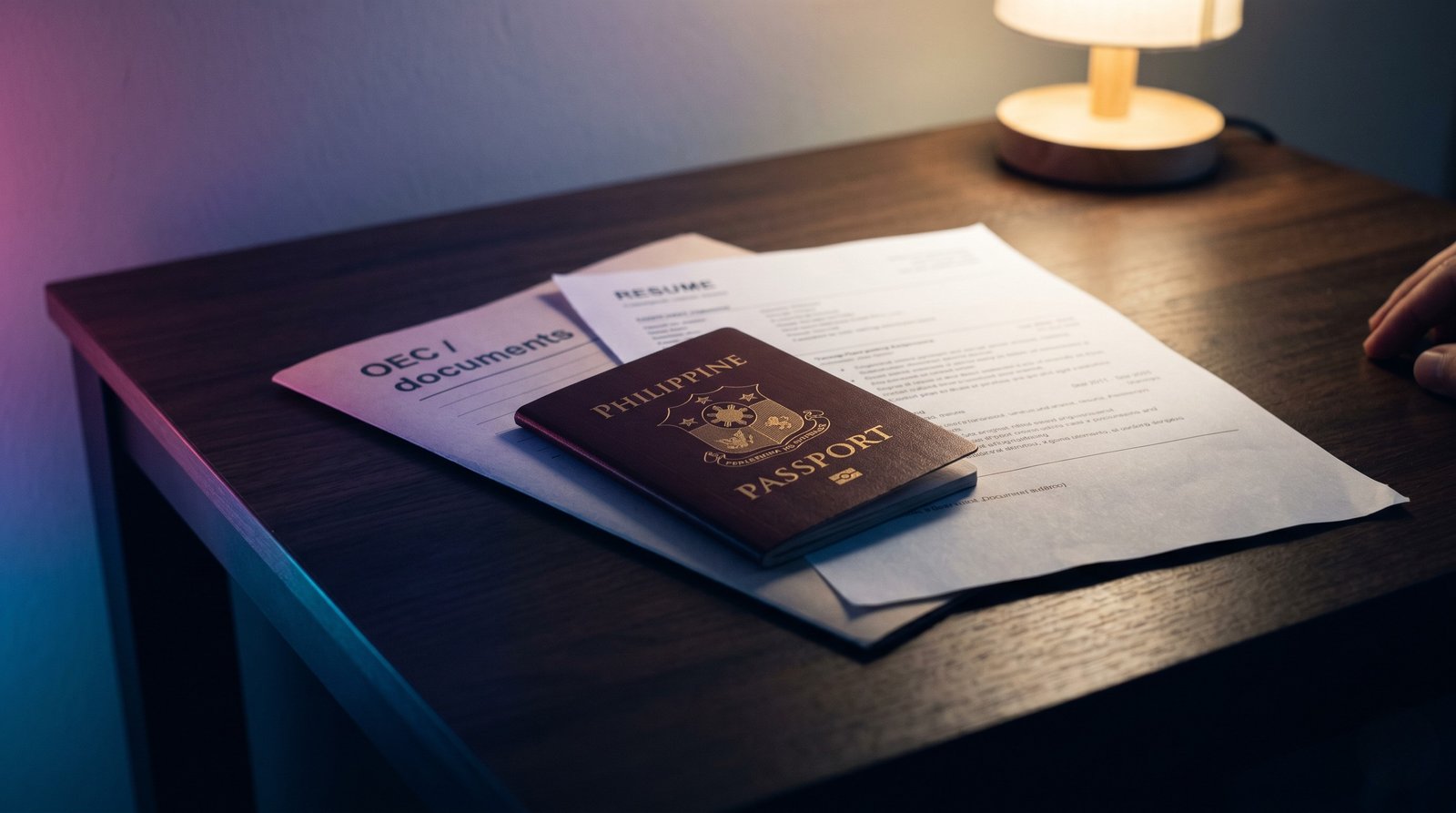
There is one more kind of readiness that has nothing to do with the resume, and it is the one I see workers leave until it is too late: your documents. Get them in order before an offer lands, so you can move the day it comes. Keep your passport valid with room to spare, and know the OEC and medical-exam steps ahead of time rather than learning them under pressure. Readiness is quiet work done early; it is what lets you say yes without scrambling.
Before You Apply: Your Starting Checklist
A few things you can act on tonight — every one of them drawn from the guidance above:
- Check the agency's licence on the DMW Licensed Recruitment Agencies list before handing over a single document.
- Build a full resume that names the exact role, your service skills, and the operations you've run — clean, specific, no fluff.
- Get your documents ready early — passport with at least six months' validity, and know the OEC and medical-exam steps so you can move the day an offer lands.
- Set job alerts and apply in the first days a role is posted — be the early applicant, not the auto-reply.
- Confirm any fee against your MOM In-Principle Approval (IPA) letter; walk away from upfront cash "to secure a job" or anything above the legal cap.
- Remember the order: a confirmed job offer comes first, and the work pass follows from it — never the reverse.
Do this well, and you give yourself a real shot at a hospitality job in Singapore that starts a career, not just a contract.
The Questions Filipinos Ask Me Most
After fourteen years, I can almost guess the questions before a worker asks them. So let me answer the ones that come up most — honestly, the way I'd tell you over coffee — before someone with an agenda answers them for you.
How does a Filipino get a hospitality job in Singapore? The order matters, so let me be plain: you need a confirmed job offer first, and the work pass follows from it — never the other way around. Your employer is the one who sponsors you and applies for that pass on your behalf; you do not file for it yourself. That is the framework MOM lays out, and it is why I warn workers off anyone promising a Singapore visa with no hotel attached — no employer, no pass, and usually no honest deal.
How do I find a legitimate employer or recruitment agency — and not get scammed? Before you hand any agency a single document, check that its licence is real on the Department of Migrant Workers' list. Two minutes on the DMW list has saved people from heartbreak I have seen too many times. Now, about fees — and hear me out, because this part is misunderstood. A fee is not automatically a scam: a licensed Philippine agency may lawfully charge up to one month's salary, collected only after your contract is signed, and nothing at all for household and service-worker categories; a Singapore employment agency may charge no more than one month of salary per year of service, capped at two months. What you walk away from is an upfront cash fee to "secure" a job, a fee bigger than those caps, or any amount that doesn't match the figure on your MOM In-Principle Approval (IPA) letter. If someone demands money before there is a contract, walk away.
What documents do I need to work in Singapore from the Philippines? A few things, and none of them are hoops — they are what protects you abroad. You will need a pre-employment medical examination, required on Singapore's side by the Ministry of Manpower and on ours through the standard OFW process, and an Overseas Employment Certificate from the Department of Migrant Workers, which makes your deployment legal on the Philippine side. Check your passport too: Singapore's Immigration & Checkpoints Authority requires at least six months of validity left before you fly.
Is hospitality a good career in Singapore? Yes — because it is a real path, not a dead-end job: you start as an attendant or front-office associate and climb to supervisor and into management, with companies that promote from within and experience recognised across the region. I lay out that whole progression in the career section above.
Which hospitality jobs pay 10k a month in Singapore? That figure is real, but it sits at the very top — executive housekeepers, executive chefs, and food and beverage directors, all on an Employment Pass. It is a career destination, not a starting offer; almost every Filipino I know began well below it and climbed.
So let me leave you where I began. You will not feel ready — almost no one does, and the people you admire did not wait for the feeling either. The readiness is built on the way, not before. Get these few things right, take the first real step while your hands are still shaking, and trust yourself to learn the rest by doing the work well. That step is yours to take. I believe you can.
Sources
- Work passes overview — Singapore Ministry of Manpower: https://www.mom.gov.sg/passes-and-permits
- Work Permit for migrant workers — Singapore Ministry of Manpower: https://www.mom.gov.sg/passes-and-permits/work-permit-for-foreign-worker
- Non-Traditional Sources Occupation List (Philippines eligibility; housekeeping/cook roles; S$2,000 floor; 1 Sept 2026 expansion) — Singapore Ministry of Manpower: https://www.mom.gov.sg/passes-and-permits/work-permit-for-foreign-worker/sector-specific-rules/non-traditional-sources-occupation-list
- Work Permit conditions (medical insurance employer obligation) — Singapore Ministry of Manpower: https://www.mom.gov.sg/passes-and-permits/work-permit-for-foreign-worker/sector-specific-rules/work-permit-conditions
- Annual leave (Employment Act) — Singapore Ministry of Manpower: https://www.mom.gov.sg/employment-practices/leave/annual-leave
- Employment Pass eligibility (S$5,600 qualifying salary, age-scaled) — Singapore Ministry of Manpower: https://www.mom.gov.sg/passes-and-permits/employment-pass/eligibility
- Employment agency fee cap and In-Principle Approval (IPA) letter — Singapore Ministry of Manpower: https://www.mom.gov.sg/faq/employment-agencies/how-will-foreign-workers-know-the-amount-that-they-are-expected-to-pay-the-singapore-ea
- Licensed Recruitment Agencies (verify an agency) — Philippine Department of Migrant Workers (DMW): https://dmw.gov.ph/licensed-recruitment-agencies
- S Pass eligibility (S$3,300 qualifying-salary floor) — Singapore Ministry of Manpower: https://www.mom.gov.sg/passes-and-permits/s-pass/eligibility
- Entering Singapore (passport six-month validity) — Singapore Immigration & Checkpoints Authority (ICA): https://www.ica.gov.sg/enter-transit-depart/entering-singapore
- Revised POEA/DMW Rules on landbased OFWs (placement-fee one-month rule; zero fee for household and service-worker categories) — Philippine Department of Migrant Workers (DMW): https://dmw.gov.ph/archives/poea/agency/files/Licensing_2016_POEA%20Rules_Landbased.htm
- OEC / deployment FAQs (Overseas Employment Certificate) — Philippine Department of Migrant Workers (DMW): https://dmw.gov.ph/faqs
- Medical examination for migrant worker — Singapore Ministry of Manpower: https://www.mom.gov.sg/passes-and-permits/work-permit-for-foreign-worker/sector-specific-rules/medical-examination