
Someone has died in another country, and the family is being asked for documents in a system they do not know.
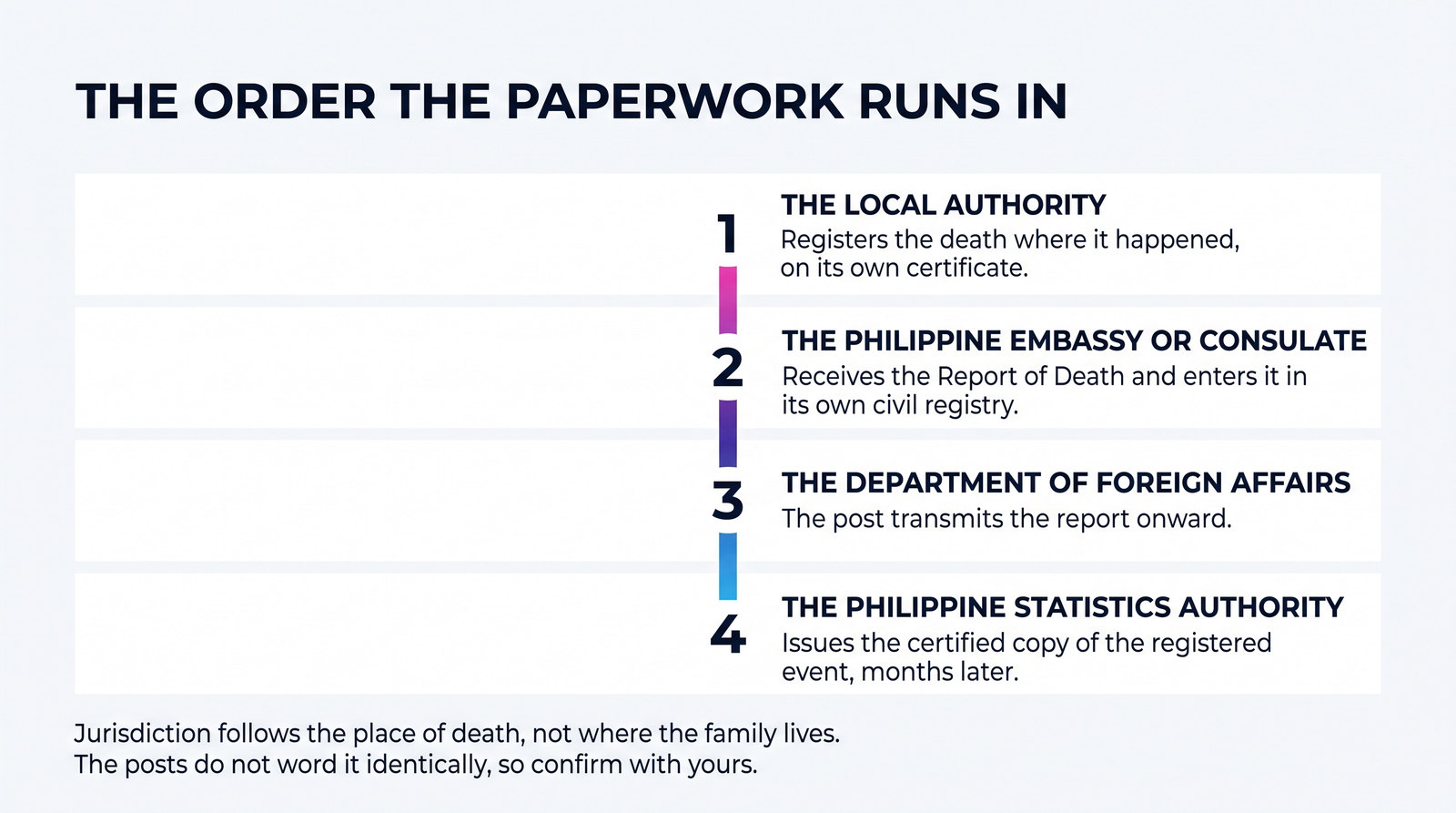
The paperwork has an order. The death is registered first where it happened, on a certificate issued by the local authority. It is then reported to the Philippine Embassy or Consulate General with jurisdiction, Canberra says, "over the place where the event took place." Los Angeles publishes an urgent hotline.
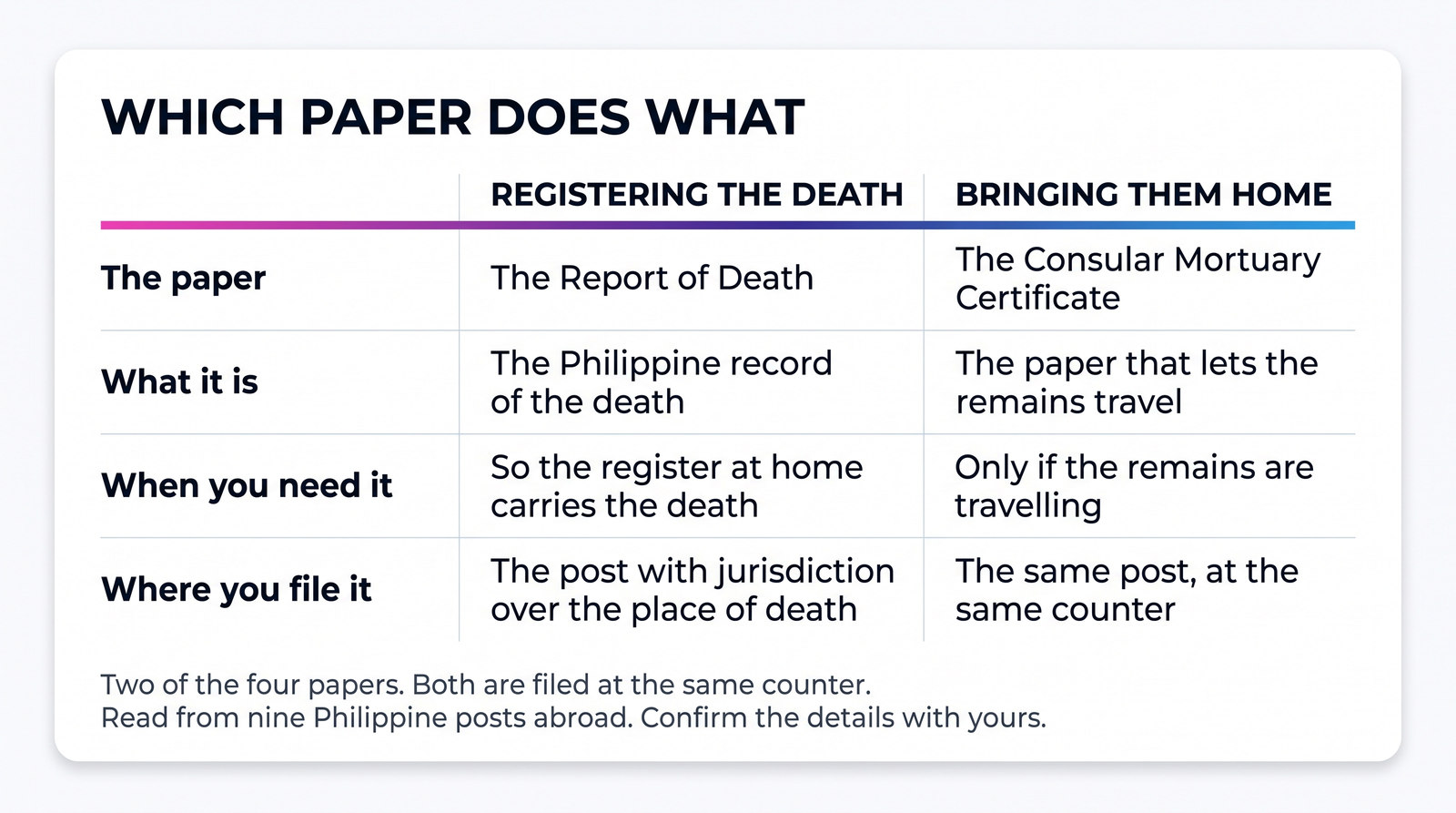
Four different papers get called, loosely, the death certificate. We read nine Philippine posts abroad to separate them.
The four papers, and which one does what
- The local death certificate. Issued where the person died — by a county registrar, a state registry, a local health office. Everything else is built on it.
- The Report of Death. The Philippine record — "a declaration that a Filipino citizen died in a foreign country," in the Philippine Embassy in Berlin's words, filed so the register at home carries it.
- The Consular Mortuary Certificate. Needed only if the remains are travelling. The Philippine Consulate General in New York issues it for human or cremated remains of a Filipino or a non-Filipino.
- The PSA copy. The Philippine Statistics Authority's certified copy of the registered event, months later, and the one most Philippine government agencies ask for.
Which post is yours, and who to call
Jurisdiction follows the place of death, not where the family lives: the Philippine Consulate General in Los Angeles registers deaths only in Southern California, Arizona, and the Nevada counties of Clark, Lincoln and Nye. The posts do not word it identically — Cairo says the nearest Philippine Embassy or Consulate — so confirm with yours.
Which section handles it varies by post: New York addresses the mailed packet to its Assistance to Nationals Section, while Los Angeles files both papers under civil registration. One line on the Los Angeles assistance page catches families out: since 1 July 2023 its assistance to distressed Overseas Filipino Workers has been handled by the Migrant Workers Office instead. Ask your post which desk handles your case.
The Report of Death: what it records, and who it is for
The report records a vital event with the Philippine Statistics Authority through the Consulate, in the Philippine Consulate General in Chicago's words. The post enters it in its own civil registry and transmits the report to the Department of Foreign Affairs. Most Philippine government agencies then accept only the PSA copy for public transactions, as the Los Angeles checklist tells applicants.
A Report of Death is required only if the deceased was a Filipino citizen who had not acquired a foreign citizenship, or a dual citizen, at the time of death. Los Angeles writes that in capitals. If your relative naturalised abroad and never re-acquired Philippine citizenship, this report is not yours to file. The mortuary certificate still is — New York and the Washington DC embassy issue it for a Filipino or a non-Filipino citizen alike, so they can be brought home.
Who may file depends on the post: Cairo accepts a family member, employer, company representative or undertaker, Canberra wants the next of kin's signature, and Chicago wants a letter-request signed by the informant.
What you send
Eight of the nine posts we read ask for four copies of the form. The shape repeats across them; the details do not.
- Four original, duly accomplished Report of Death forms. Canberra takes them notarized by the Philippine Consul, a Notary Public or a Justice of the Peace.
- The local certificate, where the counts diverge. Washington DC wants one original and four photocopies, Chicago one original and five, New York one original and three, Canberra the original and three certified true copies. Berlin and Cairo also want an English translation of it — Berlin, of every German document.
- An apostille, if you are in Australia. Canberra requires it apostilled by the Australian Department of Foreign Affairs and Trade. No United States post we read does.
- Proof of Philippine citizenship at the time of death — a photocopy of the deceased's passport data page, a permanent resident card, a work permit, a valid visa, or dual citizenship documents.
- The fee, a return envelope, and the right payment instrument.
With no valid Philippine passport, Los Angeles publishes alternatives: dual citizenship documents, or a PSA birth certificate or an expired passport — the last two with a notarized affidavit of the next of kin certifying the deceased had not acquired foreign citizenship.
The fee was USD 25 at Washington DC, New York, Chicago, Cairo and Los Angeles, EUR 25 at Berlin and AUD 45 at Canberra, read on their own pages on 10 September 2026. The amount is rarely what goes wrong; the instrument is. Chicago takes neither personal checks nor credit cards and wants a tracked envelope or a pre-paid private courier, but not FedEx.
Filing differs too: Washington DC and Chicago take it by mail only, Los Angeles accepts walk-ins, Canberra by appointment or mail, New York asks you to email the application first. At the posts we read that publish a time, it is released in three to five working days.
Two clocks run here. The post's own copy comes back in days; the PSA copy takes months, counted from different starting points — Washington DC says request it six months after approval, Berlin four to eight from reporting. Request the PSA copy through the channel your post's page names, not a search result. Our guide to the PSA documents Filipinos need for working abroad covers that stack.
A death reported more than a year late is still accepted, and there is no fine: "there is no monetary penalty for delayed civil registration of death," the Washington DC embassy states. The delay adds an Affidavit of Delayed Registration, duly notarized and executed by the next of kin, and at Berlin and Canberra a second fee, the same again. Berlin puts the window at twelve months and five other posts we read draw the line at a year, but none cites a statute — treat it as practice, not a rule.
If you are bringing them home
Apply to the same post for a Consular Mortuary Certificate: that is the paper that lets the remains travel, and it is not the Report of Death. Both are filed at the same counter — Canberra's page is built as three scenarios and the Report of Death form is required in all three. No post we read says one must be completed before the other.
It asks the people handling the remains for the following. A notarized mortuary or funeral director's certificate, stating in Canberra's terms that the body was properly embalmed or cremated and that the casket or urn is hermetically sealed and contains only the remains of the deceased. One of non-contagious disease, issued by the Health Department at Los Angeles and the Local Area Health Service at Canberra. An embalmer's certificate, a burial-transit permit, and the receiving funeral company in the Philippines named with contact details.
Cremated remains take a separate route — a notarized certificate of cremation stating that they were properly cremated and the ashes placed in a hermetically sealed urn. Where a person carries it, four posts ask for a photocopy of their passport data page, three of them with flight details.
Timing is short: Washington DC, New York and Chicago require the documents at least seven working days before the flight, and no Australian or European post we read publishes a lead time. Know where the post's part stops: it issues papers; the funeral director, the airline and the receiving funeral home have their own.
The folder nobody wants to need
The families who get through a week like this with one crisis instead of two are not braver. Their papers were already in one place — a Philippine passport, dual citizenship documents, the civil records of a life lived abroad. That is all readiness means here. It changes nothing about the loss and a great deal about the fortnight after it. Canberra keeps them at one civil registry counter: "all vital events (Report of Birth, Report of Marriage, Report of Death)" go to the post with jurisdiction.
Before you call the post
- Get the local death certificate first. Everything else is built on it.
- Find the post with jurisdiction over the place of death, print its checklist, and ask how it takes the form.
- Confirm the fee and payment instrument before buying a money order.
- If the remains are travelling, ask about the mortuary certificate in the same call.
The Questions Filipinos Ask Us Most
What do I do if someone dies in another country? Register it with the local authority where it happened, then report the death to the Philippine Embassy or Consulate General with jurisdiction. At New York the packet goes to the Assistance to Nationals Section; at Los Angeles it is filed under civil registration.
How do I bring a body or ashes home to the Philippines? Apply to the same post for a Consular Mortuary Certificate. Washington DC, New York and Chicago each want the papers seven working days before the flight.
How many days does it take to get the death certificate? It depends which copy. At the posts we read, the post's own takes three to five working days; the PSA copy takes about four to eight months.
What if the death happened in the Philippines? Then it is not a consular report. Under Act No. 3753, "no human body shall be buried unless the proper death certificate has been presented and recorded in the office of the local civil registrar."
Sources
Report of Death — Los Angeles PCG: https://losangelespcg.org/consular-services-2/civil-reg1stry-2/report-of-death-of-a-filipino-abroad/
Mortuary certificate and Report of Death checklist, May 2026 — Los Angeles PCG: https://losangelespcg.org/wp-content/uploads/2026/05/Requirements-for-CMC-and-ROD.2026.pdf
Assistance to Nationals — Los Angeles PCG: https://losangelespcg.org/other-services/assistance-to-distressed-filipinos/
Report of Death and shipment of remains — New York PCG: https://newyorkpcg.org/pcgny/civil-registration/report-of-death-of-a-filipino-abroad-shipment-of-remains/
Report of Death — Philippine Embassy, Washington DC: https://philippineembassy-dc.org/report-of-death-application-by-mail/
Shipment of remains — Philippine Embassy, Washington DC: https://philippineembassy-dc.org/shipment-of-remains/
Report of Death — Chicago PCG: https://www.chicagopcg.com/reportofdeath.html
Report of Death — Philippine Embassy, Berlin: https://philippine-embassy.de/report-of-death/
Report of Death and shipment of remains — Philippine Embassy, Canberra: https://www.philembassy.org.au/consular/civil-registry/report-of-death-rod-and-or-shipment-of-human-remains-urn-to-the-philippines
Reporting a vital event — Philippine Embassy, Canberra: https://philembassy.org.au/consular/civil-registry/reporting-a-vital-event-which-occurred-outside-australia-and-philippines
Report of Death — Philippine Embassy, Cairo: https://www.philippines-egypt.com/ro-death
Act No. 3753, An Act to Establish a Civil Register: https://lawphil.net/statutes/acts/act1930/act_3753_1930.html